


SingaporeMotherhood | Baby & Toddler
July 2026
Mud, Not Flashcards: How Nature-based Preschools in Singapore Do It Differently

Eiling Goh is a counsellor and psychotherapist, a mother of three, and the founder of a nature-based preschool in Singapore. Before she built Whistle Woods Schoolhouse, she spent over a decade working with families at the sharp end of early childhood stress. The children were rarely the problem, she says. The system was. She kept hearing the same thing from parents who were thoughtful, well-intentioned, and quietly exhausted: it starts too early, too fast, and there is no soft place to land.
Eiling is not alone. Across Singapore, a small but growing number of preschools have built their entire curriculum around nature-based learning, self-directed play, and an unhurried approach to early childhood. These are not schools that bolt outdoor time onto a conventional programme. They are schools where the philosophy shapes everything — from the daily rhythm to how teachers measure progress.
This guide introduces six nature-based preschools and three forest school programmes for parents curious about what play-based learning actually looks like in practice.
(See also: Free Play vs Structured Play: What’s the Difference & Does Your Preschooler Get Enough?)
Why Now — and Why Parents Are Still Hesitant
Singapore’s conversation about childhood anxiety, screen time, and AI in education has grown louder. More parents are questioning whether worksheets at three and tuition at five are truly preparing their children or simply pressuring them.
The research backs what many intuitively sense. Free play builds executive function, emotional regulation, and sustained focus. From her clinical work, Eiling observes that unhurried children typically display greater self-confidence and lower anxiety, while heavily scheduled children often struggle with autonomy. A common telltale sign, she says, is a constant need for reassurance — repetitive questions like “Are you sure? Am I allowed to do this?”
Yet the fear of falling behind is real. Eiling’s response is measured: some pressure is okay, but the key is timing. You don’t throw someone into the sea without first making sure they can swim. Children need to build strong fundamentals first, so that they develop the ability to handle pressure.
Then there is technology. Is a tech-free preschool outdated in an AI world? Eiling states that screens disrupt how attention develops, and that the ability to sustain focus is one of the greatest predictors of future success. But this is not about resisting the future, she adds. AI represents technical knowledge, and knowledge can be acquired at any age. In early childhood, the mission is to shape who children become.
(See also: Anxiety in Children: How to Help Your Child Keep Calm & Carry On)
Nature-based Preschools in Singapore
1. EtonHouse Garden School by the Bay

This is the first and only preschool located inside Gardens by the Bay — and the curriculum grew directly out of that setting. Opened in 2023, the purpose-built campus was designed around three pillars: nature education, sustainability, and community.
EtonHouse holds that the environment is the third teacher, so classrooms connect organically to communal spaces. Children spend half their time outdoors in the gardens themselves. Beyond that, they work with nature education specialists and horticulturists from Gardens by the Bay. The school also built its own outdoor learning spaces: a biophilic play area, a bioactive terrarium, a discovery pond, a bug hotel, and a sensory garden.

The Supertree Playground nods to the school’s location, while an explorer mezzanine deck offers sensorial experiences. Sustainability runs through daily practice — the school reduces plastic use, cuts waste, and harvests its own crops. The aim is for children to become change agents in their own communities. A boutique infant care programme runs in a dedicated space within the preschool.
Ages 9 months–6 years
Where Bayfront Pavilion, 18 Marina Gardens Drive
Web etonhouse.edu.sg/school/gardens
2. Nurtured Nest

Nurtured Nest builds its curriculum on three approaches at once: Reggio Emilia, Forest Schooling, and sustainability education. The school’s stated aim is to fully immerse children in learning in the natural world and equip them with rich learning experiences.
The Reggio influence shows up in the space itself. Filled with natural materials and muted tones, the environment is engaging without being overwhelming, and children split into small groups for different activities. Forest Schooling supplies the child-led backbone. The school describes it as a long-term outdoor education process, holistic and learner-led, where children develop through healthy engagement with risk, problem-solving, and self-discovery.

Children spend hours outdoors daily, rain or shine, experiencing the changing landscape, weather, flora, and fauna. Weekly Forest Classroom visits add storytelling and story-making. Sustainability, meanwhile, is embedded from management through to curriculum — the school’s stated goal is to raise a conscious generation.
Ages 18 months–6 years
Where 644 Dunearn Road
Web nurtured-nest.com
3. Odyssey The Global Preschool – Dempsey

At Odyssey’s Dempsey campus, the forest is the classroom. Inspired by the Reggio Emilia approach and guided by the International Baccalaureate (IB) Primary Years Programme, the school views its environment as the ‘third teacher’, encouraging children to explore, question and construct knowledge through meaningful experiences. Children shape their learning through curiosity and hands-on investigation rather than instruction.
Literacy and numeracy are woven into inquiry-based projects rather than taught in isolation. A dedicated Chinese Language teacher remains with each class throughout the day, interacting primarily in Mandarin to foster authentic language acquisition within everyday learning experiences. Progress is tracked through ongoing documentation, not worksheets. Outdoors, the school takes an all-weather approach — children explore in sunshine and splash in puddles in boots and raincoats, moving indoors only during lightning alerts.

Teacher-to-child ratios sit below ECDA standards: 1:4 for toddlers, rising to 1:10 for K1 and K2. The school partners closely with parents through events and initiatives such as Parents-in-Class activities, where parents share their knowledge, skills, and passions to promote optimal learning outcomes for children. By the time they transit to primary school, Odyssey graduates demonstrate confidence, independence, critical thinking skills, and the ability to collaborate naturally.
Ages Toddler–K2
Where 29 Harding Road
Web theodyssey.global/sg/dempsey
(See also: 8 Expert Strategies to Build your Child’s Self-esteem and give them Confidence in Life)
4. Roots & Boots

Roots & Boots began with a question: what exactly makes a school, a school? The founders landed on community — teachers, children, parents, and caregivers coming together. Then they asked why that community had to sit indoors. The answer is a preschool without walls, which the school describes as a first in Singapore.
Its Urban Forest School approach integrates Reggio Emilia, Montessori, and Project Approach into a fully outdoor early childhood education. The curriculum covers the expected ground: language and literacy, numeracy, discovery of the world, physical and motor skills, and the creative arts. For the youngest children, learning is experiential and sensorial, with the natural environment acting as their third teacher.

For five- and six-year-olds, the inquiry-based curriculum balances academic skills with life and social skills. Children observe, reason, analyse, and problem-solve, while each outdoor experience weaves in opportunities for character building. As the school puts it, more than preparing children for school, they believe in preparing them for life. You will spot them in fluorescent vests wherever their boots take them.
Ages 18 months–6 years
Where Botanic Gardens | East Coast Park | Other green spaces islandwide
Web rootsandboots.sg
5. Waldorf Steiner Early Years Centre

Singapore’s only Waldorf early years centre has been doing things differently since 2003 — long before nature-based education became a talking point. Run by a non-profit, volunteer-led association, it began when five mothers started a weekly playgroup in a private home.
Everything is built around rhythm. Each weekday has its own character, named after the shared meal children prepare: Monday is Rice Day, Tuesday is Bread Day, Wednesday is Idli Day. Fridays are spent entirely outdoors. There are no worksheets. Instead, literacy grows through oral storytelling and songs. Numeracy emerges through baking, counting, and pattern recognition. Self-directed learning takes the form of extended free play with open-ended, natural materials — though clear, loving boundaries keep the freedom purposeful.

The centre maintains a ratio of 1:4 to 1:7. Graduates have transitioned successfully to local primary schools, international schools, and homeschooling. Reported strengths include strong attention span, genuine curiosity, and confidence in social settings. Some families opt for a bridging programme before Primary 1; others focus on emotional readiness.
Ages 18 months–6 years
Where 72 Jalan Senang
Web waldorf.sg
6. Whistle Woods Schoolhouse

Whistle Woods opened in May 2025 near the Bukit Timah Nature Reserve. Founder Eiling Goh, a counsellor and psychotherapist turned educator, built the school around what she observed in over a decade of clinical practice with families under early childhood pressure.
The result is a boutique preschool capped at 36 children, blending Waldorf and Montessori methods. It is 100 per cent tech-free during school hours. Natural materials fill every space — wood, metal, silk, ceramic — and nature walks happen rain or shine. Eiling describes the school as strongly guided by European traditions (they celebrate Midsummer with flower crowns) but balanced with Asian sensibilities.

As an ECDA-certified preschool, Whistle Woods follows the NEL framework with twice-yearly assessments and portfolios. A K2 bridging programme prepares children for Primary 1, though Eiling is upfront: if parents want a school that pre-teaches P1 content, that is not what they offer. What graduates carry, she believes, is something more durable: independence, self-agency, and the creativity that comes from years of engaging with open-ended materials.
Ages 18 months–6 years
Where 2A Hindhede Road
Web whistlewoods.com
(See also: 12 Types of PreSchools in Singapore: The Ultimate Guide)
Not Ready for Full Forest Preschool? Try These Nature-based Enrichment Programmes
Not every family wants a nature-based setting for their child, of course. Some might prefer regular sessions to complement conventional preschool education. While there are many such enrichment programmes in Singapore, we narrowed it down to three that stand out, each with a genuinely different approach.
Gentle Seeds
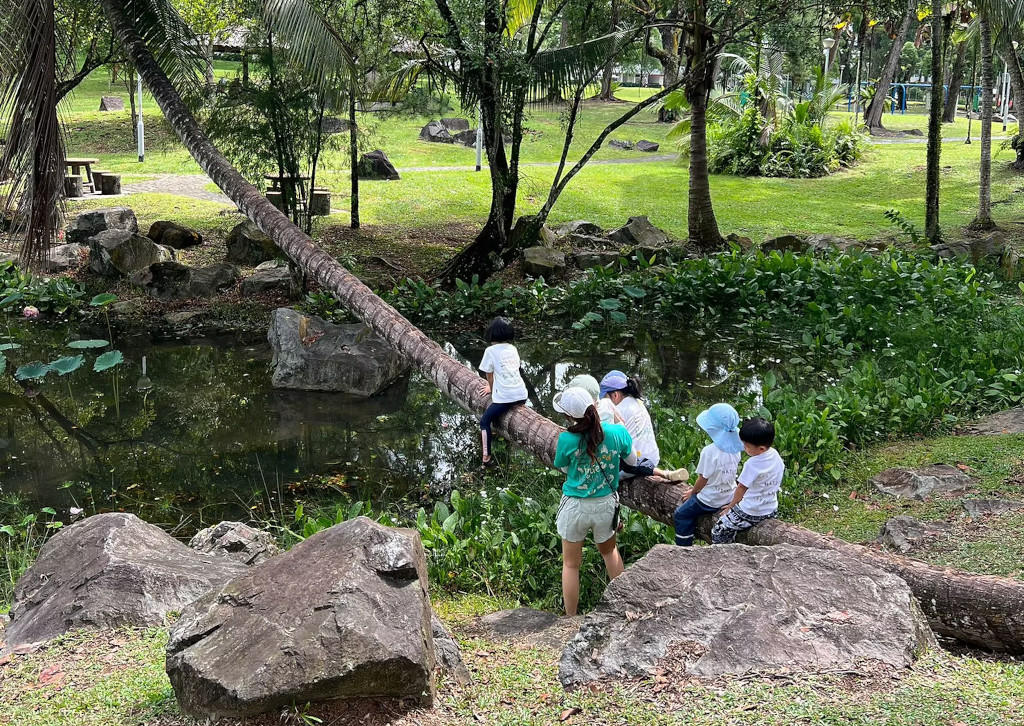
Gentle Seeds pairs nature with literature, drawing on Charlotte Mason’s philosophy. Weekly Nature Study sessions follow MOE school terms, each built around a theme like plants or insects, with a pause midway for a snack and a story. Along the way, children organically develop three foundational habits: observation, attention, and obedience — the last being less about compliance than a love of truth. When a child says “the flower is yellow”, they are practising truthfulness. They believe in inspiring children with ideas, because ideas are like seeds that will bear fruit someday! Holiday programmes and bespoke sessions are also available.
Ages 2–12 years
Where Bishan-Ang Mo Kio Park | Bidadari Park | Botanic Gardens | Pasir Ris Park
Web gentleseeds.com
Nature Explorers School
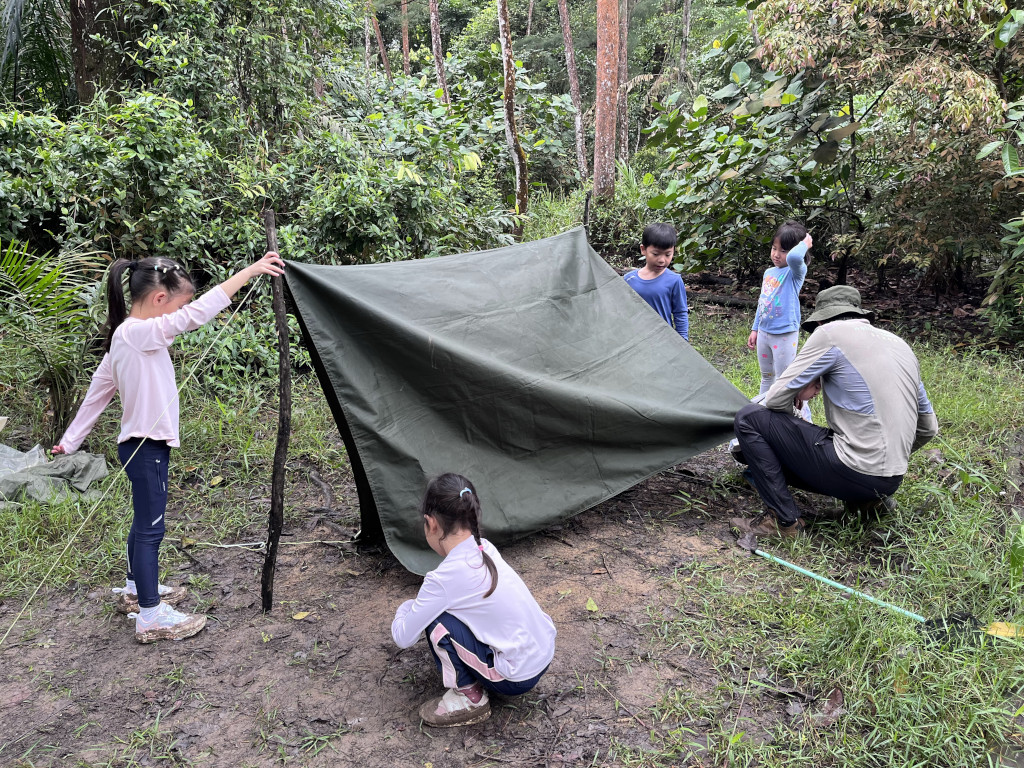
Nature Explorers School has run entirely outdoor, child-led sessions in green spaces around Singapore for over seven years. Weekly 2.5-hour sessions take children into a forest base camp where they decide what to do — from mud kitchens to rope play to rock mining. Founded by Jenson Ong, a certified Level 3 Forest School Leader, the programme maintains a maximum ratio of 1:6. Sessions run rain or shine, closing with forest bathing and a sharing circle.
Ages 3–12 years
Where Alexandra Forest | Mount Faber | Pasir Ris Park | Other green spaces islandwide
Web natureexplorersschool.com
Wildlings Forest School
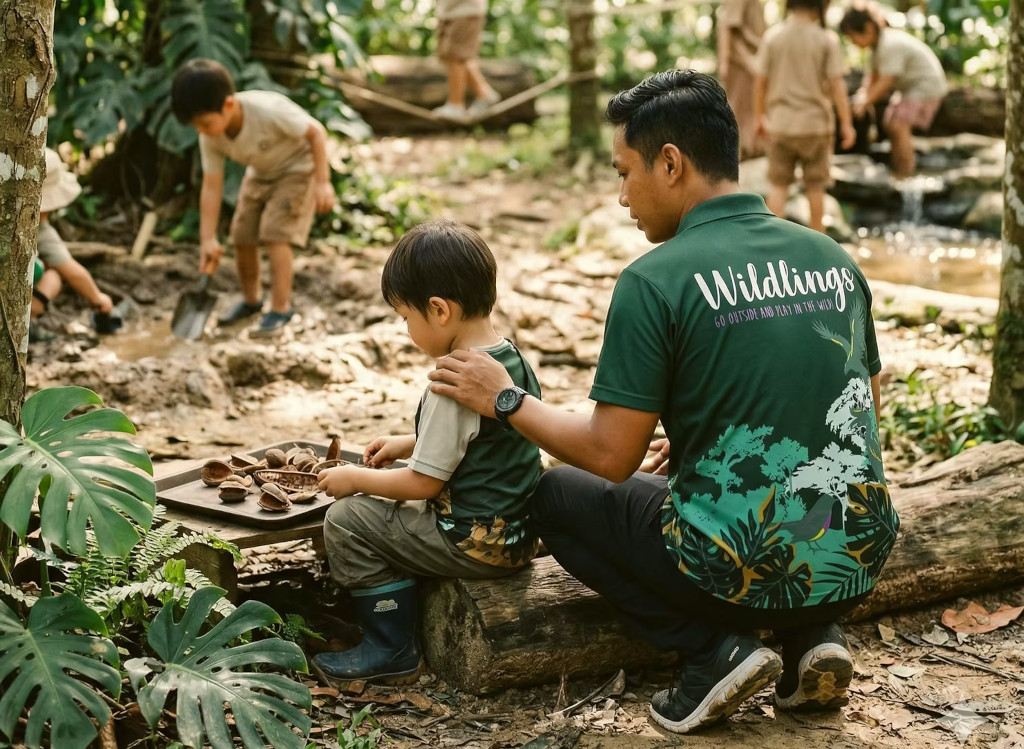
Wildlings is Singapore’s most established forest school — and the only one that manages its own land. Founder Claire Seabrook, a certified Level 3 Forest School Leader, built purpose-designed spaces with sheltered areas, lightning protection, and showers, solving Singapore’s weather problem by design. The programme runs with a clear progression: the youngest make their first spark with a fire striker; the oldest earn a campfire licence. Claire recommends consistent, long-term attendance — roughly 34 to 36 weeks a year — because that is how a forest school does its real work.
Ages 18 months–12 years
Where 27A Loewen Road | 40 West Coast Ferry Road
Web wildlings.sg
(See also: Worldschooling: Taking Homeschooling to Another Level)
What to Ask When You Visit
Choosing play-led, nature-based preschools can feel like a leap of faith, especially in Singapore’s competitive landscape. Whether you are attending a preschool open house or forest school trial session, these five questions will help you assess whether the philosophy is genuinely embedded — or just good marketing.
- Can you show me what a child’s learning documentation looks like? Schools that take play-based learning seriously will have detailed observation records, not worksheets. Ask to see how they track a child’s growth over time.
- What happens on a rainy Monday morning? The answer tells you whether outdoor learning is a daily commitment or a fair-weather add-on. Look for rain gear, all-weather policies, and sheltered outdoor spaces.
- What does your K2 year look like? Good nature-based preschools will have a thoughtful approach to the Primary 1 transition — even if it does not involve worksheets. Ask about bridging programmes, literacy and numeracy foundations, and what past graduates’ experiences have been.
- What is your teacher-to-child ratio — and is that the ratio on paper or on the ground? Smaller ratios make child-led learning possible. Ask what happens when staff are absent and how the school maintains quality when group sizes fluctuate.
- How do you involve parents beyond drop-off and pick-up? The strongest programmes treat families as partners, not audiences. Look for hands-on involvement, regular communication, and a genuine sense of community.
Featured image: Depositphotos
All content from this article, including images, cannot be reproduced without credits or written permission from SingaporeMotherhood.
Follow us on Facebook, Instagram, Telegram, and TikTok for the latest article and promotion updates.

