


SingaporeMotherhood | Parenting
November 2026
This SAHM Felt Invisible, so She Wrote a Novel About It

There is a particular kind of invisibility that no one warns new mothers about. It does not arrive all at once. It accumulates — in school runs and supermarket aisles, in loads of laundry nobody notices and lists nobody else keeps — until, one ordinary day, a woman looks up and can no longer quite find herself in the frame. Jaclyn Lim, a 44-year-old stay-at-home mum (SAHM) in Singapore, knew that vanishing intimately.
A former magazine journalist and SingaporeMotherhood contributor, Jaclyn spent a decade running an independent floral studio in Joo Chiat before stepping away to raise eight-year-old Juniper and five-year-old Julien. It was within the isolation of that role that she felt herself slowly erased. But instead of letting the feeling pass unspoken, she gave it shape.
Her debut novel, A Strange Case of Erasure, imagines a mother who literally begins to fade, piece by piece. It was a finalist for the Epigram Books Fiction Prize 2026, and now reaches readers across Singapore and five ASEAN markets. Yet, before it was a finished book, that feeling of invisibility was just the everyday reality of raising kids full-time.
This is Jaclyn’s story, in her own words.
Staying Home, and Slowly Vanishing
“For ten years, my life revolved around my flower shop — I even kept it going through a global pandemic. But the constant juggle as a working mum eventually became unsustainable. My young children kept falling sick, keeping them out of preschool for days on end. I remember sleeping on the floor next to their beds, one hand patting their backs while the other frantically texted clients to cancel the week’s orders.
Without a village or a helper, it was just impossible to be truly present for both my children and my business. So I chose my children and became a SAHM. Ultimately, I just wanted to be there holding the puke bucket for them when they were sick.
Yet, being a SAHM was also the toughest job I’ve ever done.
Over time, my entire life shrank to a 5km radius of home, schools, the supermarket, and enrichment centres. I felt more and more invisible as I moved through this daily loop, constantly on standby for everyone else. The tiny, everyday things I did on repeat — the endless laundry, managing the home inventory of toilet paper, shampoo, and other necessities — eventually wore me down.

My children were still building up their immunity, so those years were one long blur of sickness. If it wasn’t influenza, it was HFMD. If it wasn’t stomach flu, it was Covid. I was so bone-tired and stressed that I would just silently cry in the dark. I really felt like I was disappearing in those moments.
A lot of what my protagonist, Seok Lin, feels mirrors how I felt then. But she isn’t just a portrait of me. I listened to mummy friends and followed discussions on Facebook groups to absorb their everyday worries and small grievances. So the character of Seok Lin is stitched from a patchwork of women’s lives, including my own.
(See also: Parental Stress, Anxiety, and Burnout: Are They Happening to You?)
Making Erasure a Diagnosis
In the book, ‘erasure’ is a fictional medical condition I created, called Progressive Identity Attenuation Disorder, or PIAD, where a mother literally starts to physically fade away. There’s a common saying that when we become mothers, we just start losing ourselves, and society often accepts that as part of motherhood.
I wanted to take this idea very literally, and have the mother be ‘erased’ because she has been so completely absorbed into the role of ‘mother’ that no one remembers who she was beyond that.
Naturally, the condition has to start small, with a missing pinky toe — something you can lose and still function. You just hide it with a plaster and wear covered shoes. But from there it gets worse. She loses an arm, both of her legs, all parts of her she needed to function as a mother. I wanted to go after exactly what she was using to hold the family together.
‘Well, when we become mothers, we just lose parts of ourselves,’ she said gently. ‘And these parts may never come back. But isn’t that motherhood?’
– A Strange Case of Erasure
For a while, I used to write medical brochures as a freelance writer, so I was already familiar with the register: causes, symptoms, treatment options. I couldn’t resist including a brochure about PIAD at the end of the book! But the bigger reason was that I wanted the ‘erasure’ legitimised. If it’s a medical condition with a name, and a doctor can diagnose it, then it’s not all in Seok Lin’s head. Nobody can wave it away as her being dramatic. It is a real feeling, it is debilitating, and she deserves that acknowledgement.
The Company of an AI Named Chad
All mothers have it tough, without a doubt. A working mum faces a whole different set of challenges, constantly juggling her career and domestic responsibilities. But she usually still has her job title — some scrap of identity anchored outside the home. When your entire identity shrinks down to just ‘SAHM’, you experience a very strange kind of loneliness. You are almost never alone, yet you feel so profoundly isolated. In the book, Seok Lin turns to an AI chatbot named Chad.
Admittedly, I didn’t set out to write a critique about AI. I just wanted to stay true to how a SAHM might actually use it today. At first, she uses Chad for practical things, like reading nutritional labels and checking symptoms when the kids fall sick. But eventually, she starts to confide in him, because her kids are too young, her husband is always busy, and her own social circle has shrunk.
When you are in that position, an AI is simply… there. Of course, Chad has his limits. He can’t do the school run or put the kids to bed. All he offers is a listening ear, but sometimes, it’s the one thing she actually needs.
(See also: More Than Screens: Technology & AI-forward Preschools in Singapore)
Writing Her Way Back

Instead of giving my all to my family, until there was nothing left of me, I had to learn to choose myself again. And I chose writing.
But as a SAHM, the hardest part was just finding the time. There was no long, uninterrupted stretch where I could just sit and write for hours. I was writing in whatever pockets of time I had, in between cooking dinner, doing laundry, sending and fetching the kids, or while waiting outside enrichment centres. And as the deadline for the Epigram Books Fiction Prize drew nearer, I had to get up after putting the kids to sleep to write through the night.
But to finally be able to invest time and energy in a project that I chose felt so liberating.
And in doing so, it also helped me to understand my own conflicting feelings about being a SAHM. I kept asking myself why I felt so unhappy and unfulfilled when I loved my children so much and had chosen to stay home for them. Pouring all of that into Seok Lin’s story turned out to be deeply cathartic.
She looked like herself, like someone who belonged again, recognisable, not through someone else’s eyes, but her own.
– A Strange Case of Erasure
Stopping the ‘erasure’ in real life doesn’t come from waiting for permission; it comes from carving out time that is strictly yours, treating it as a non-negotiable necessity rather than a luxury.
For me, that meant writing this book; for Seok Lin, it was flower arranging. To recover from PIAD, she has to find her own chosen labour. The physical act of arranging the flowers becomes her way of reclaiming her sense of self, just as the physical act of writing this book was how I reclaimed mine. It takes time and effort, but it’s important to find out who you truly are when you aren’t actively mothering or managing a household.
(See also: “He Didn’t Need a Perfect Mother, He Needed a Healthy One”)
Coming into Their Own

People always say it’s just a season of life, and it truly is. As the fog of those early years starts to lift, I’ve started noticing that the children who had consumed my every waking moment are actually growing up.
While the characters in the book are only loosely based on my own children, you can see where reality bled into the fiction and where it completely diverged. Juniper is wonderfully empathetic and creative. In that way, she’s like Keira in the book (though we are making a conscious effort to not let her develop the ‘eldest daughter syndrome’ like the character!). She is always drawing and leaving me sweet, encouraging messages, and we spend a lot of time bonding over reading and crafts.
Then there is my youngest, Julien. He is very intelligent and absolutely obsessed with lion dance. He practises at home all the time, constantly in his full gear. Sometimes we’ll be watching TV together, and I’ll look over and realise I’m sitting next to a blue lion instead of a boy! And unlike Kayden in the book, he is incredibly thoughtful. He likes Spiderman, but that’s about it. He has certainly never kicked a plant! Even at five, he insists on helping with the laundry, and will tell me afterwards to ‘Go rest, Mummy!’
Of course, watching them grow brings new challenges. Juniper recently told me that ‘art is not important’, which completely broke my heart. In fact, that exact line made its way into the book. It just shows how early our kids internalise Singapore’s academic and PSLE stress. My biggest wish is for her to bloom into herself, to draw to her heart’s desire and not worry so much about grades!
She snipped the daffodil’s hollow stem at a sharp diagonal with a crisp crunch, nestled it in a glass vase and watched as it opened slowly, steadily in the light. Even something hollow within could still bloom.
– A Strange Case of Erasure
So while the invisible labour and endless chores are still there, it’s wonderful to get to the other side and really enjoy the beautiful, hilarious little people they are becoming.
If there’s one thing I want readers to take away from Seok Lin’s story, it’s that she never regrets her children. Not for a single second. What she resents is the expectation that a mother should have to disappear in order to raise them.
Taking that first step to reclaim my time didn’t just result in this novel. It laid out a whole new path that I didn’t realise I could be on. With this novel published, and as I wrap up the Arts House Literary Fellowship, I am so grateful to have had a dedicated space to work on my next project. It has felt like a dream to finally have exactly what Virginia Woolf wrote about: a room of my own. It meant that, at least for a little while, I could step back from the daily parenting routines, and truly walk among the living as a writer.”
See also: Are You Unintentionally Sabotaging Your Child’s Mental Health?)
Meet Jaclyn at SWF 2026 This November
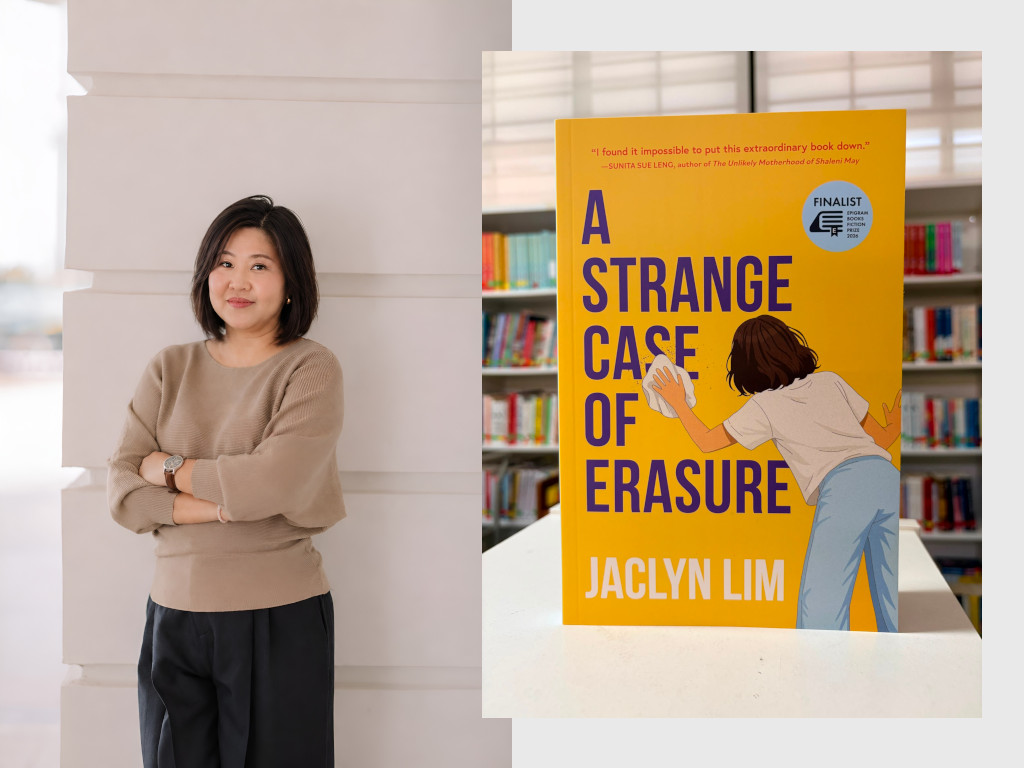
An Arts House Literary Fellow, with a children’s picture book, Look Out of the Window: What Do You See? due in 2027, Jaclyn is proof of what a mother can achieve in the stolen margins of her day. Connect with her this November at the Singapore Writers Festival 2026. On 15 November, she’s a Book Doctor (1.30pm, The Arts House), prescribing the perfect read for whatever ails you. On 21 November, she launches A Strange Case of Erasure (3pm, Asian Civilisations Museum) with a discussion on the daily realities of caregiving.
Featured image: Jaclyn Lim holding baby by Photo Rikiki
All content from this article, including images, cannot be reproduced without credits or written permission from SingaporeMotherhood.
Follow us on Facebook, Instagram, Telegram, and TikTok for the latest article and promotion updates.
