


SingaporeMotherhood | Pregnancy
March 2026
Undergoing Breast Augmentation after Baby & Breastfeeding

After five years of breastfeeding, Q (not her real name) was unhappy with the way her breasts looked. “There was volume loss and my breasts were looking deflated, even smaller than pre-pregnancy,” the 36-year-old said. “I wanted to restore them to have a more youthful look.”
The mum of two had done a fat transfer from her thighs and her waist to her breasts three years ago. However this did not give her breasts the volume she desired. Chancing upon the Preservé method of breast augmentation on a social media post got Q curious.
“I was attracted by the minimally invasive nature of Preservé, and the faster post-op recovery compared to traditional breast augmentation. Since I wanted a relatively smaller increase in volume — below 200 cc — I was advised by my doctor that I might be a suitable candidate. My original cup size was between A and B, and now it is between B and C.”
Breast Augmentation in Singapore
- Worldwide, breast augmentation is the second most popular aesthetic surgical procedure.
- In Singapore, which is the first in Asia to use Preservé, breast augmentation accounts for about 30 per cent of aesthetic procedures.
- The demand for breast augmentation in Singapore has risen by an average of about 50 per cent compared to five years ago.
- Most patients here are between 25 and 44 years old, followed by those in the 45 to 54 age group.
- Across Asia, most patients tend to be older (35 to 54 years), financially able, and highly motivated.
- Many seek breast augmentation to address underdeveloped breasts or post-pregnancy deflation, and most prefer natural-looking, subtle, and proportional results.
Source: Preservé clinics
Preservé Breast Augmentation: a Sustainable Procedure
Preservé preserves breast tissue during the procedure as opposed to modifying the anatomy of the breast and chest muscle in order to accommodate an implant.
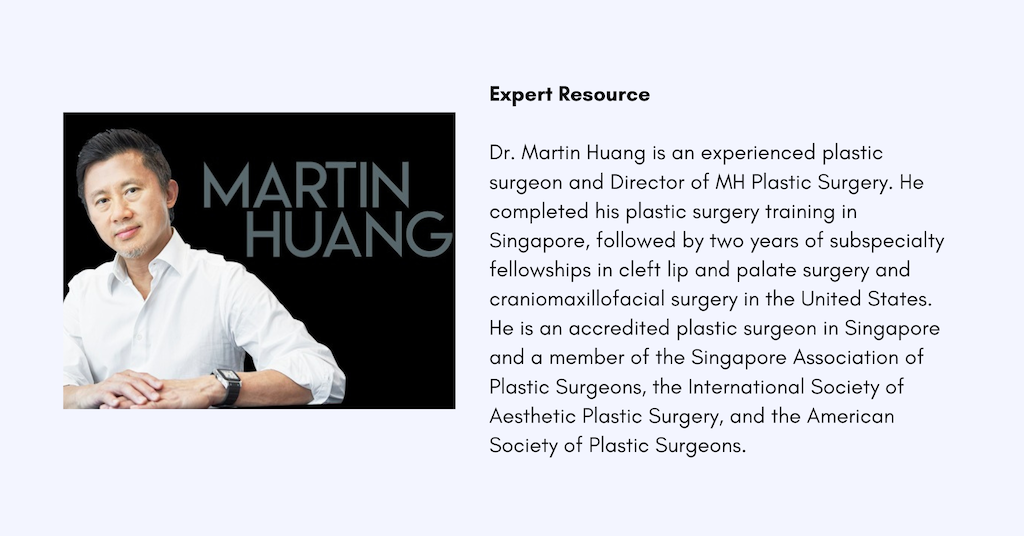
“A useful analogy is to compare Preservé with biophilic architectural design, where natural elements are preserved and integrated into built environments,” explains Dr. Martin Huang of MH Plastic Surgery, who performed Q’s breast augmentation in December 2025.
“Similarly, with Preservé, the natural elements of the breast, particularly the breast ligaments, are preserved and integrated into the surgically built environment for the implant.

Preservé resonates well with the current era of sustainability and environmental protection. It focuses on protecting and preserving the native environment of the breast, with the goal of ensuring that the breast, the implant, and the patient as a whole can thrive together,” he adds.
“Preservé is an innovative and minimally invasive technique of breast enhancement with quick recovery for a specific group of patients who would not otherwise consider breast augmentation.” — Dr Martin Huang
Minimally Invasive; a Quicker Recovery
As a minimally invasive breast augmentation procedure, Preservé can be done under intravenous sedation rather than general anesthesia. This leads to a faster recovery and an earlier return to daily activities such as work, childcare, travel, and exercise.
“As I was under sedation and not under general anesthesia, I woke up feeling really good. It was as though I had just taken a nap,” recalls Q. “There was no pain at all, except that it felt heavier on my chest due to the post-operation swelling.”
Three days later, Q was back at work. “Even my husband was amazed at how fast I recovered. I did not take a single painkiller, not even Paracetomol. There was only some discomfort from the heaviness and swelling which subsided significantly after the first week.”

Preserving Breast Ligaments for Support
Contributing to a speedy recovery is the fact that with Preservé, implants go directly under the breast and on top of the chest muscle. This makes it unnecessary to surgically modify the muscle. The Preservé technique also preserves the ligaments of the breast so that they can surround and support the implant.
“This helps to camouflage the margins of the implant, making them less visible. The result is more natural looking than the conventional breast augmentation technique,” says Dr. Huang.
A Better Sense of Self
For Q, the procedure, which cost her around $21,000 (without Medisave or grants), has been worth every dollar.
“I am very satisfied with the results,” she says. “I am also very grateful to Dr. Huang who listened to my desire for a smaller implant size. Prior to seeing him, I went to another doctor who told me that I didn’t have a choice except to take a larger implant in order to look good. I probably wouldn’t have tried Preservé if I didn’t get the support from Dr. Huang. I have no regrets at all.”
Studies have reported positive sexual outcomes for women after breast augmentation. For Q, this proved to be true as well. “A few weeks post-op, when the swelling has subsided, it (sexual relations) is very manageable. I just needed to be careful about the incision site. I was more confident about how I look, and I could feel his (my husband’s) excitement,” she shares.
Ultimately though, any cosmetic or plastic surgery change should be done for yourself. “Following your heart and what matters to you is a very personal decision that you should safeguard,” says Q. “It hasn’t changed the way I see myself as a woman and a mother, but it does bring joy and confidence in wearing clothes and filling up bra cups which I previously couldn’t.”
(See also: POSTPARTUM INTIMACY: HOW TO KEEP THE SPARK ALIVE POST-BABY)
Breast Augmentation: The Lowdown

Thinking about enhancing your breasts after baby and breastfeeding? We asked Dr. Martin Huang what you should know first:
⏰The best time to do breast augmentation.
Three to six months after childbirth without breastfeeding, when the body as a whole and the breasts in particular are close to their pre-pregnancy state. Three to six months after stopping breastfeeding, so that breast size has stabilised and no significant changes in breast volume and shape will occur.
❌Who should not do breast augmentation?
Anyone who has active breast cancer or who is in the process of being treated with radiation therapy and/or chemotherapy. Similarly, those who have uncontrolled or poorly controlled medical conditions such as, interalia, diabetes, hypertension, heart disease, and obesity should avoid breast augmentation.
⚠️Common risks to be aware of?
Breast augmentation is generally a very safe procedure, with minimal blood loss and a very low risk of infection.
The main risk of breast implants is capsular contracture. When an implant is placed in the body, the body’s immune system produces a layer of scar tissue around the implant which encapsulates it. This is known as the implant capsule.
If the capsule remains thin and soft, there is no adverse effect on the implant. However, if the capsule becomes thick and starts to contract, it will make the implant feel too firm, and may cause the implant shape to become too round, and hence unnatural looking.
This complication is known as capsular contracture. While not dangerous, it compromises the aesthetic result and is unpleasant for the patient.
❤️🩹How long does recovery take?
With Preservé, the recovery period is one to two days in terms of return to normal daily activities such as work and childcare. Travel is safe after two to three days. Exercise may be resumed after two to three weeks.
🫣What if I don’t like how it looks and feels?
Barring the complication of capsular contracture, this is an extremely rare and unlikely scenario. It can be avoided by (i) ensuring that the patient is given a very clear and detailed consultation so that she fully understands what is involved; (ii) employing rigorous and reliable processes of helping the patient to determine the best implant size and shape for her based on her breast and chest anatomy, and her personal preferences and objectives.
🤕What about scarring?
Like all scars on the torso, the scars from breast augmentation take a somewhat lengthy time to fade, ranging from one to two years for a fully faded, pale and inconspicuous scar. This time frame is similar to that of a C-section scar.
Measures are taken to to minimise scarring, such as using smaller incisions, wound closure techniques that minimise tension across the wound, and wearing surgical tape over the wound and scar for a period of time after stitches have been removed to further minimise skin tension and stretching of the scar.
💐Is nipple sensation affected?
This risk of injuring the nerve that supplies sensation to the nipple can be minimised by ensuring that the width of the implant is not wider than the patient’s own breast width. This is because this nerve usually exits from the chest wall and into the breast along the lateral (outer) boundary of the breast. As long as this precaution is observed, this risk can be kept to less than one per cent.
😷Does breast augmentation increase my breast cancer risk?
Undergoing breast augmentation does not have any effect on breast cancer risk. It also does not affect breast cancer detection.
💡How should I monitor my breasts after the procedure?
Perform monthly breast self-examinations. Check daily that the implants feel soft, and immediately inform your plastic surgeon if they start to feel firm. Attend all follow-up appointments (including the long term annual checkups) so that your surgeon can monitor your implants for you. Undergo regular ultrasound and mammogram imaging at intervals advised by your attending surgeon.
📅Will my breasts look different over time?
Like all parts of the body, the breasts are subject to ageing. However, having breast implants usually slows down the appearance of ageing of the breasts. They may gradually look “looser” and less perky as the years go by, but they are less likely to sag as compared to breasts without implants.
🤱🏻Can I breastfeed in the future if I have another baby?
Yes, breastfeeding is definitely possible after a breast augmentation.
Featured image: Depositphotos
All content from this article, including images, cannot be reproduced without credits or written permission from SingaporeMotherhood.
Follow us on Facebook, Instagram, Telegram, and TikTok for the latest article and promotion updates.

