SingaporeMotherhood | Parenting
October 2017
Bonding with Your Baby through Art and Play
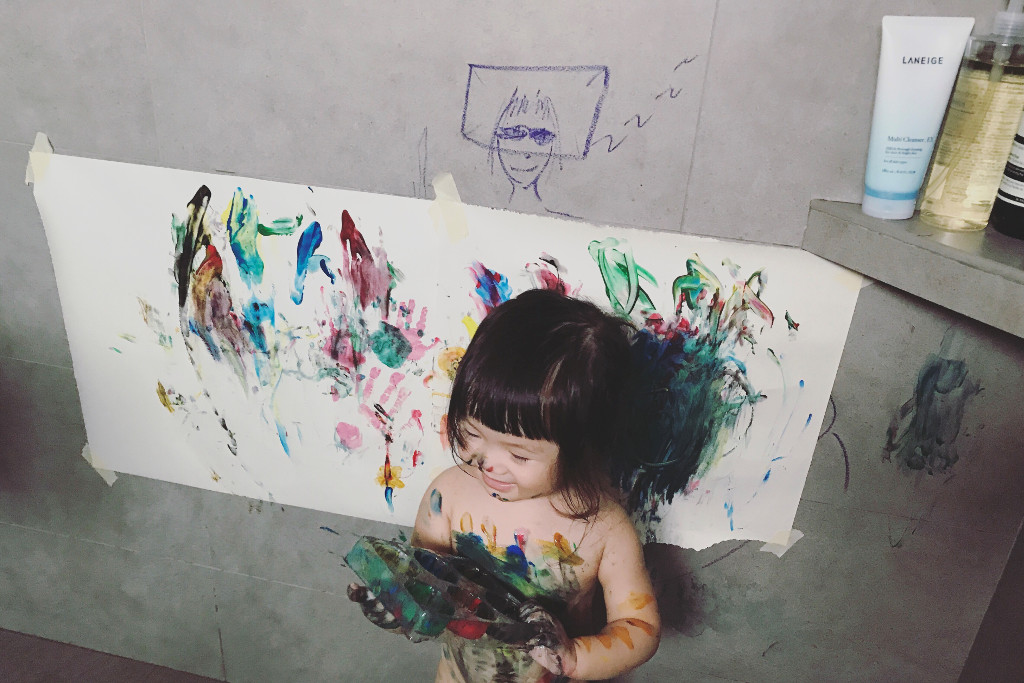
Did you know that art encourages all-rounded education and development for children?1 David A. Sousa, an international consultant in educational neuroscience and author of book How the Brain Learns, also found that much of what children do as play engages all senses and wires the brain for successful learning.2 A child’s growth not only depends on important factors such as having the right nutrition and stimulation. Activities like making and enjoying art — whether self-created or made by others — also contribute to the overall development of the child.3
Introducing art and craft during playtime can be easy and fuss-free. Read on as Ginette Chittick, mum of one and lady of many hats (she’s a lecturer at LASALLE College of the Arts, fashion designer, musician and artist!) shares how she incorporates art into play with her daughter Luella.

“From a young age, I’ve always loved singing and it helped that my dad always encouraged me to visualise scenarios and make up stories to the tunes and songs that I sing. This has definitely influenced the way I interact with and teach Luella, who has a great imagination and loves engaging in pretend-play.”
Colours and Shapes
Between the ages of nine to 12 months, babies’ physical development allows them many different opportunities to play and move. Their hand-eye coordination and fine motor skills are also maturing, and they become fascinated with learning about objects.4
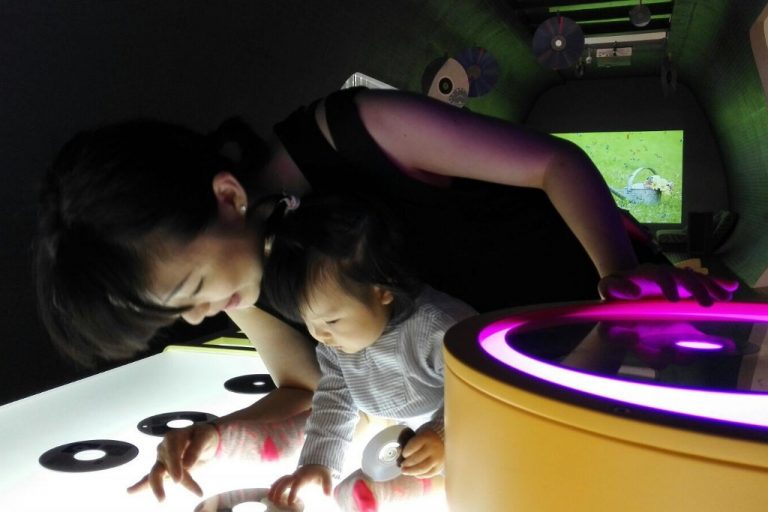
To teach Luella about shapes, Ginette sketched three baskets and prepared 10 sets of three shapes cut out in different colours for Luella to paste using starch glue. “I let Luella sort them out one by one and paste them in the appropriate basket, to let her differentiate what shapes belong together and what shapes are different,’’ says Ginette.
With colours, Ginette uses a descriptor in different ways so as to help Luella better understand the concept of colours. “When showing Luella a purple flower, I would say: Look at that purple flower! Its colour is purple. This flower is purple in colour. This is to help her understand my point in a few different ways and reinforce the concept of colour.”

“Introducing these art and visual stimulations has brought about many benefits. Luella speaks really well for her age, and she can already identify light and dark tones of colour easily. She can also identify shapes really well! Encouraging Luella to imagine what her paintings and creations are have also helped with her creativity! We have drawn butterflies, peacocks, elephants and even waterfalls during play time together.”
Fun and Meaningful ‘Art-ivities’
“Drawing and painting during bath times is one of the best ways to incorporate some messy fun with your baby. I get non-toxic washable crayons and paints for Luella to doodle on the bathroom walls and she gets all the creative freedom to express herself, without me having to worry about cleaning up a huge mess after!”
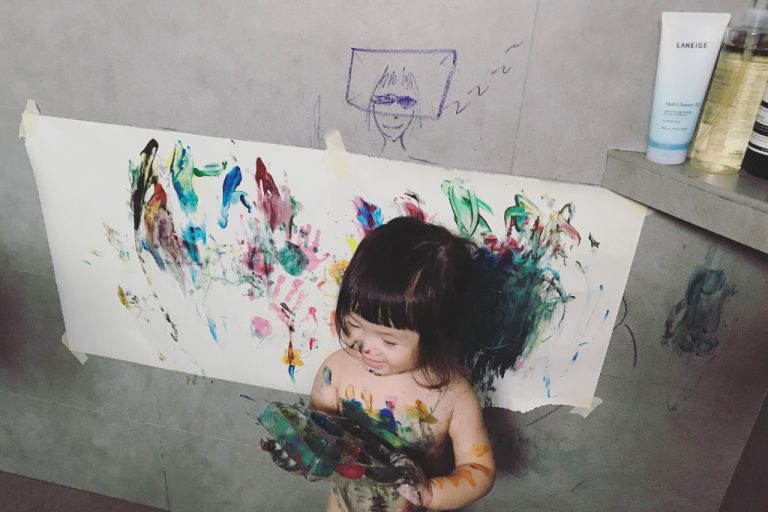
Another way to unleash your child’s artistic skills is to get them to paint your own wrapping paper for gifts. Ginette bought a ream of paper from Ikea’s children’s department and she let Luella paint on the paper before bath time. This then became an exclusive piece of wrapping paper designed specially by Luella, and a meaningful gift for the receiver.
“I strongly encourage parents to use art and music to stimulate their babies’ senses. It definitely opens up a whole new world of possible activities that you can design for your child during play time.”
Support Your Child’s Continuous Learning Moments
While engaging in art and craft can be a fun way to teach children basic concepts, nutrition also plays an important role in helping your child’s continuous development.
Believe it or not your brain is made up of fats — a lot of it! At a basic cell level, fats and fatty acids help build the brain, eyes and central nervous system of your developing baby. DHA and ARA are two specific types of long-chain fatty acids which are critical to this healthy development. DHA and ARA — which can be found in formula milk like Enfamil A+ Stage 2 — are important building blocks of brain and eye development.
Find out more about Enfamil A+ Stage 2 and how it supports your child’s nutritional needs below.
Why choose Enfamil A+ Stage 2?
Enfamil A+ Stage 2 with 360° DHA PLUS is a high quality and nutritionally balanced follow-on formula designed for infants after the age of six months. It provides advanced nutrition for supporting growth and physical development.
It is the only Stage 2 formula with scientifically formulated levels of 17mg▲ DHA and 34mg▲ ARA, which help meet nutritional recommendations♦ for infants aged 6–12 months. This formula also contains Choline to help support overall mental function, and a unique blend of PDX (Polydextrose) and GOS. Prebiotic (GOS) stimulates the growth of beneficial intestinal flora to maintain a healthy digestive system.
Also Available: Enfagrow A+ with 360° DHA PLUS
Formulated for children aged 1–3 years old, Enfagrow A+ with 360° DHA PLUS is an advanced milk formula for your child’s overall mental and physical development. It contains a scientifically formulated blend of DHA (an important building block for brain and eye development for children), Wellmune®Beta-Glucan, Dietary fibre (PDX), and Prebiotic (GOS).
▲ per 100kcal
♦ FAO/WHO recommends daily dietary DHA intake of 10-12mg/kg body weight for children 6-12 months. Reference: FAO 2010. Fats and fatty acids in human nutrition. Report of an expert consultation. FAO Food and Nutrition Paper No.91.FAO: Rome.
▪ This nutrient function claim only applies to products for children up to 3 years of age
PDX refers to Polydextrose
Beta-Glucan refers to Yeast Beta-Glucan
For more information about Enfamil A+ Stage 2 and Enfagrow A+ Stage 3, click here.
Note: Breast milk is the best for babies. The World Health Organization recommends exclusive breastfeeding for the first six months of life. Unnecessary introduction of bottle feeding or other food and drinks will have a negative impact on breastfeeding. After six months of age, infants should receive age-appropriate foods while breastfeeding continues for up to two years of age or beyond. Consult your doctor before deciding to use infant formula or if you have difficulty breastfeeding.
1 http://littlelearnersnews.com-us.com
2 http://www.aasa.org/SchoolAdministratorArticle.aspx?id=7378
3 http://littlelearnersnews.com-us.com
4 http://www.leapfrog.com/en-us/learning-path/articles/learning-through-year-one
Images courtesy of Ginette Chittick. This is a sponsored post.
All content from this article, including images, cannot be reproduced without credits or written permission from SingaporeMotherhood.
Follow us on Facebook, Instagram, Telegram, and TikTok for the latest article and promotion updates.